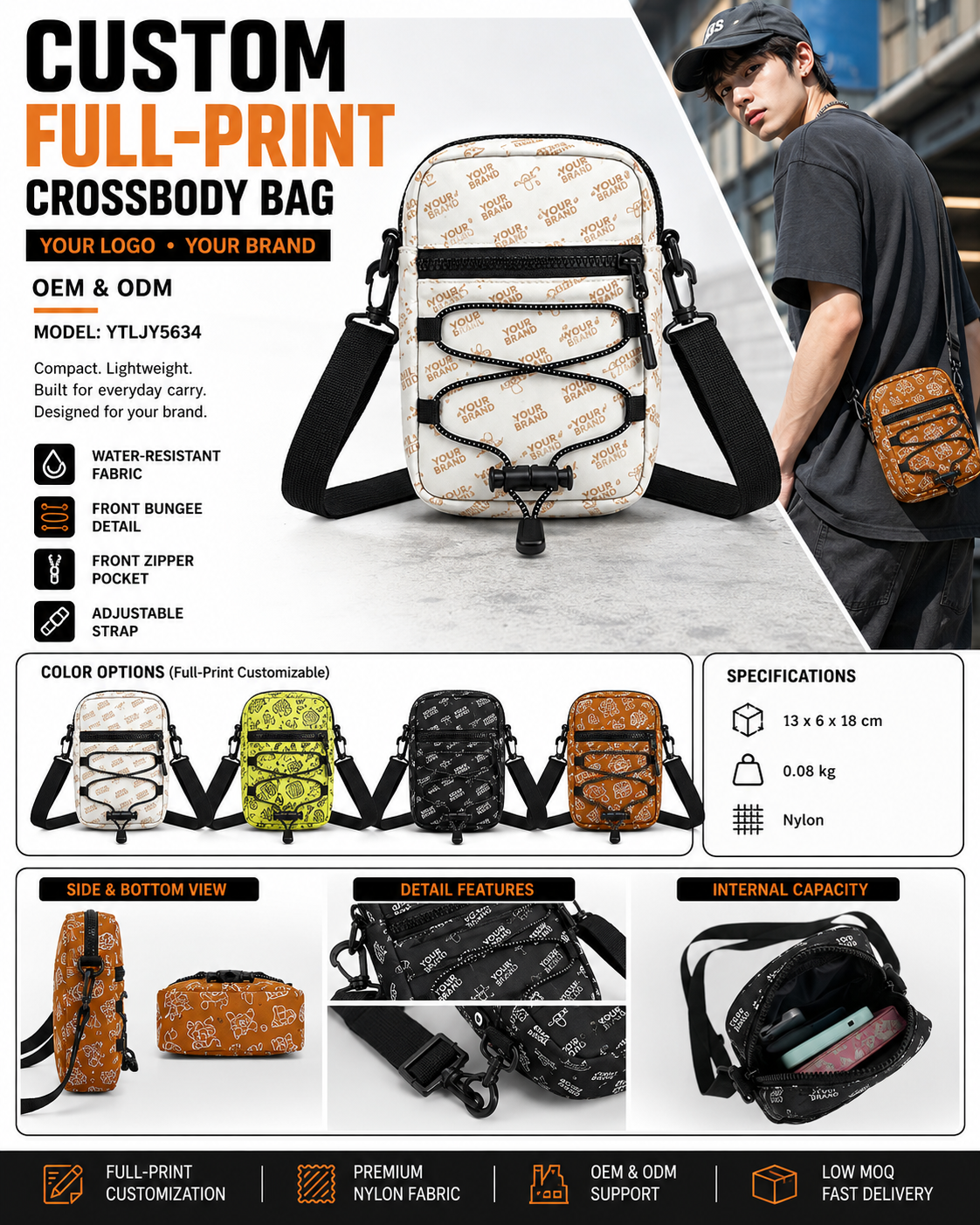
Start with the wearing scene
Crossbody products sell best when the style is clear: city commute, travel, sports, daily carry or promotional events. Confirming the usage scene first helps decide pocket layout, strap width, zipper direction and artwork placement.
Plan the full-print artwork
All-over printing should be treated as a full product system, not only a logo on one panel. Repeating logos, monogram patterns, geometric artwork and outdoor-inspired graphics all need mockups before sampling.
How do you lay out artwork on a small or curved crossbody panel?
A crossbody front panel is small and often curved, and it is printed flat before it is cut and sewn. Build the artwork on our die-line for that style, not on a rectangle. Extend the pattern 15 mm past every panel edge, keep logos and text 20 mm inside the trim line, and keep them clear of the zip line and any front pocket or bungee detail.
Use a repeat, not one centered image. On a curved panel a single centered image distorts at the edges and breaks at the seams; a repeat pattern continues across them.
Place the main logo on the largest uninterrupted area. On a style with a front zip pocket, such as YTLJY5634, that is usually the pocket face or the panel above it, not across the zip.
Check the direction when worn. A crossbody hangs at an angle, so look at the mockup the way the bag will be worn and confirm which way is up for the pattern.
Keep small text simple. Small text needs at least 6 pt and a single solid color; fine lines need at least 0.5 pt.
Send the pattern tile as well as a tiled preview, so the repeat can be scaled to each panel.
Then check all of it on the mockup before sampling, and on the physical sample before bulk. An existing crossbody style with your own full-print artwork starts at MOQ from 50 pcs*.
* MOQ and sample lead time vary by product and customization requirements; confirmed with your quotation.
Check the functional details
Buyers should review water-resistant fabric, front zipper pockets, bungee details, adjustable straps and internal capacity before confirming the order. These details affect cost, user experience and customer reviews.
Approve sample before bulk production
A physical sample helps confirm color, print scale, stitching, hardware and packaging. For private label orders, sample approval is the key checkpoint before mass production.